

November, 2009
E ngage your Audience Emotionally in your Presentations
|
Quote of the month: "Emotion is the fast lane to the brain." –Doug Stevenson To watch some outstanding clips on emotional eloquence, click on the Media Gallery on Doug's site: www.storytheater.net. 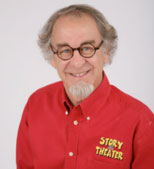 "When you speak, take them on a roller coaster ride of emotions." –D.Stevenson |
Opening: Do effective speakers engage an audience intellectually with statistics, facts and figures? I'm sure you responded: "No, they don't because effective speakers know that people are never moved to action intellectually, they're moved emotionally, so when planning and presenting a speech they ensure that the audience is emotionally engaged in the 3 components of a speech: the structure, content and delivery."
Promise: If you work hard on only 1 or 2 of the triangular parts, your presentation will fall below the average level and you may lose your audience. On the other hand, if you work hard on all 3 components - structure, content and delivery...you'll be strides ahead of other speakers since your message will be memorable and you'll move audiences to action to better their lives.
Roadmap: This month, we will look at six behaviours to avoid and their counterparts, (2 each from structure, content and delivery) to emotionally engage your audiences.
Just because you say something, it doesn't mean the audience will remember it. As a speaker, don't you want you and your message to be remembered and repeated?
TIPS on EMOTIONAL ENGAGEMENT with Your AUDIENCE through your:
1. Structure: HOW you set up your presentation
2. Content: What you say
3. Delivery: How you say it
| THINGS TO AVOID | THINGS TO DO |
Be unclear about your message |
Be very clear about your message |
Write a 9 minute speech and try to say it in 7 |
Write a 5 min. speech and say it in 7 |
| Never grab their attention at start - state unpleasant 'pleasantries' e.g., "Great to be here." "Wonderful weather we're having." etc. |
Have them at "hello" -smile and make eye contact -open with a bang: a question, story, statistic or quotation - see my April 2008 newsletter for more detail on these openings |
| Make it all about you, the speaker, or use only 3rd party stories, none of your own They will think "So what? Who cares? What's in it for me? There is nothing here for me!!" Result? They zone out. |
Make it all about them, the audience Use 'I' Focused stories, 'You' focused messages; at the start, frame the message and its benefits; connect with them throughout by using rhetorical questions, eye contact, and the most important connective word "you." |
| Talk AT the audience - pontificate - be superior/special/ know-it-all - make yourself the hero or guru with all the answers |
Talk WITH the audience - be conversational - make someone else or the process you learned the hero - draw on your similarities with your audience by being humble/human and discuss one or a few of your F's: your Firsts, Flaws, Fears, Failures, Frustrations |
Stay at the same energy level Be careful though and avoid being constantly dynamic as that would be sameness too! "Those who sleep in noise, awake in silence." –C. Valentine |
Alter your levels of energy throughout Ensure your voice and body language are congruent with the spoken words and appropriate reaction to the situation. Use a different tone, when stepping out of your story and making a point to the audience. |
Most of all, share a lesson, have fun, go on a journey, and take the audience with you with a solid structure, connecting content and dynamic delivery!!
As a speaking coach, I know that all too often speakers work so hard on the structure and the content of their presentations, that they don't spend much time working on their delivery. I will suggest an invaluable resource in which I invested last year. This set of CD's and DVDs will provide you with great DYNAMIC DELIVERY DEVICES DVD Set by Craig Valentine which, in turn, will set you apart from average speakers.
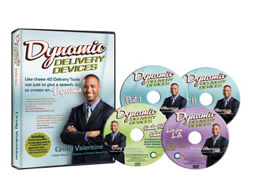
Don't just give a speech; create an unforgettable experience!
If you could have a surefire way to hook your audience for your entire speech, would you want it? How about 40 surefire ways?
Have you ever looked into the eyes of your audience and realized you lost them? How did that feel? Wasn't it frustrating knowing you prepared long and hard but didn't get the reaction you wanted? This is what happens to speakers who master content and structure but don't put equal effort into mastering the art of delivery. They bang their heads up against the same wall that they simply cannot break through.
Order now and receive FREE access to Craig Valentine's downloadable Advanced Speaking Toolkit ($97 value) which includes 22 ten minute audio lessons to help you master the art of public speaking! Click here: Dynamic Delivery Devices
Join me next month when we examine and discuss the letter "F" as it relates to another speaking skill.
In the meantime,
Happy Speaking!

Kathryn@kathrynmackenzie.com
416.489.6603
If you wish to unsubscribe from these newsletters, please click here. On the other hand, if you know someone who may benefit from these newsletters, please forward them. Thank you.
www.kathrynmackenzie.com
© 2009 All rights reserved